
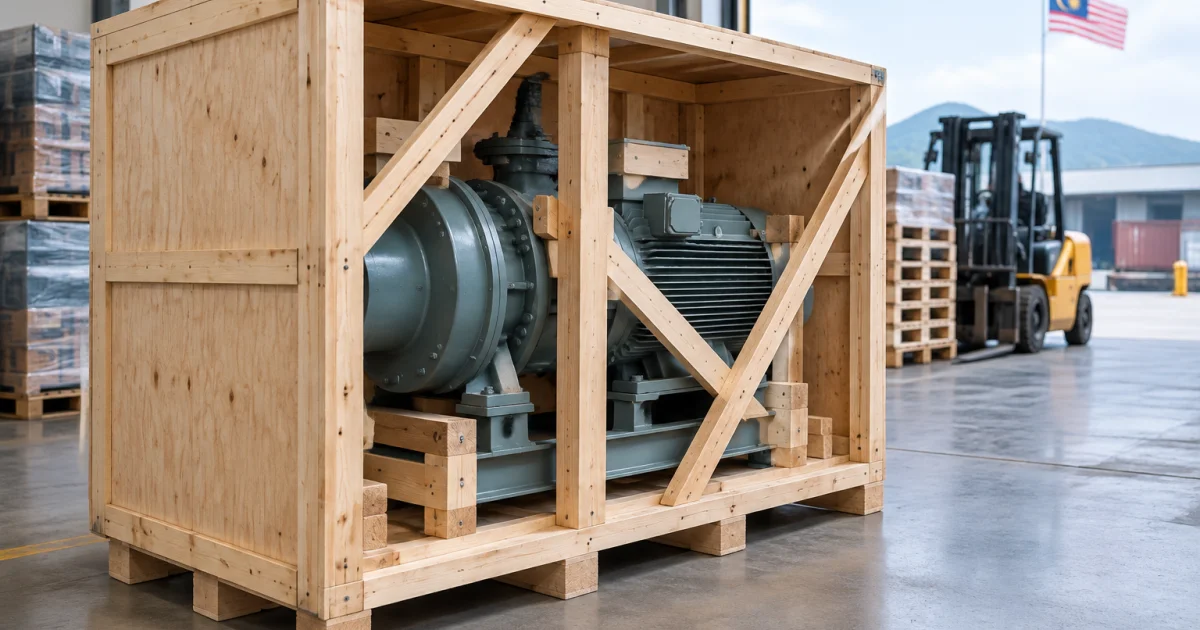
When you ship heavy machinery overseas, “standard packaging” is rarely standard enough. In my experience, export failures usually don’t come from a single big mistake—they come from small compromises: a pallet that flexes too much, a crate that’s too roomy so the load can shift, missing bracing for lift points, or timber treatment that isn’t correctly documented.
That’s why Custom wood crates so often outperform off-the-shelf packaging for machinery exports. Not because custom automatically means “premium,” but because it forces your packaging to match the load: its dimensions, centre of gravity, lifting method, and real-world handling risks from factory to destination.
Below is a practical, opinionated breakdown of where custom crating tends to win—especially on total cost, damage risk, and export compliance—and how to decide what level of customization you actually need.
Standard packaging vs custom crating: what “standard” usually misses
Standard export packaging is usually built around averages: typical box sizes, typical forklift handling, and typical loads that aren’t unusually tall, dense, or top-heavy. Heavy machinery is the opposite. It’s often compact but extremely dense, has irregular shapes, has protruding components, and may have sensitive parts that cannot take shock loads or side impacts.
Here are the gaps I see most often with standard solutions:
- Weak points aren’t supported. Machines often have specific base rails, skids, or lift pockets that must take the load—standard packaging may spread weight onto areas that weren’t designed for it.
- Incorrect clearance leads to movement. Too much internal space increases shifting, vibration, and strap loosening over long voyages.
- Handling assumptions are wrong. A “universal” pallet might be fine for warehouse moves but not for crane lifting, side loading, or multi-leg transport with cross-docking.
- Export requirements are treated as an afterthought. For international shipping, compliant timber treatment and clear marking matter as much as physical strength.
Custom crates aren’t just a wooden box. Done properly, they’re a load-control system: base + bracing + fastening + access points + treated timber + documentation. That combination is what standard packaging usually fails to provide.
Total cost: custom can be cheaper when you count the whole shipment
It’s fair to say custom crating can cost more upfront than a generic crate or “standard” wooden pallet-and-wrap approach. But heavy machinery exports rarely succeed on upfront cost alone. The more honest comparison is total landed risk cost: damage probability, inspection delays, re-crating, returns, and the internal time your team spends firefighting.
Custom crating tends to reduce total cost through a few mechanisms:
1) Better fit can reduce oversize shipping penalties
A crate that’s too large wastes cubic volume. A crate that’s poorly designed may require extra timber “just in case,” making it heavier and larger than necessary. A custom design can be built tighter around the machine while still protecting protrusions and allowing safe handling. That can help you avoid paying for “air” and reduce space issues in containers or on flat racks.
2) Fewer add-ons and improvisation at the dock
Standard packaging often turns into last-minute add-ons: extra blocks, extra straps, extra stretch wrap, makeshift bracing, or a rushed attempt to close gaps. Those extras are real costs—and they often hide weak engineering rather than fix it. A well-specified custom crate plans bracing, anchor points, and closure methods upfront.
3) Less rework after inspections or before loading
When export packing looks uncertain, shippers and handlers may request reinforcements, or an inspection may trigger re-crating. Rework costs more than doing it right once—especially when schedules are tight and the machine is already staged for dispatch.
Opinion: If the machine is high-value, heavy, or difficult to replace, treating packaging as a “minor line item” is a false economy. Packaging is part of the shipment’s engineering, not decoration.
Damage risk: custom crates control movement, shock, and handling errors
Most machinery damage happens in predictable ways: movement inside the package, tipping risk, side impacts, or compression from stacking/pressure points. Standard packaging is usually designed for general protection; custom crates can be designed for your machine’s failure modes.
Load immobilisation: the real difference-maker
For heavy equipment, the goal is not just to surround the product—it’s to stop it from moving. Custom crating can incorporate:
- Internal bracing and blocking sized to the machine’s base and frame geometry
- Anchor points for bolting, banding, or through-skid fastening (rather than relying on friction)
- Corner blocks and shock-resistant buffering where impact is most likely during handling
- Designed forklift entry and clearance so forks don’t strike critical parts
This matters because vibration and repeated micro-impacts during road legs and ocean transit can loosen fasteners and shift loads over time. A crate that starts “fine” can become dangerous after multiple transfers. Custom bracing is a way to keep the machine stable throughout the entire chain.
Base design: pallet vs skid vs crate base
A common weak link is the base. Many exporters treat the base like a generic wooden pallet. But heavy machinery often needs a purpose-built skid or crate base designed to distribute weight and resist twisting when lifted.
Custom base design can account for:
- Point loads from machine feet or rails
- Centre of gravity and tipping threshold
- Where slings or forks will actually engage
- Whether the shipment will face side lifting, not only bottom lifting
If you already use wooden pallets for parts and general cargo, that’s great—just don’t assume the same pallet spec is safe for a multi-ton machine. When in doubt, engineered pallet or skid design is worth considering.
Compliance: ISPM 15, IPPC marking, and why paperwork matters
For machinery exports, compliance isn’t limited to your commercial documents. Timber packaging itself is often regulated for phytosanitary reasons. If your shipment uses solid wood packaging components, many destinations require compliance with ISPM 15, typically shown via IPPC marking and supported by proper treatment processes.
Custom crating frequently improves compliance simply because it’s built through an export-focused workflow, including timber selection and treatment planning. Practically, that means:
- Heat treatment or kiln drying is planned into production, not added as a last-minute request
- Marking and traceability are handled correctly on the final packaging
- Less mixing of unknown timber sources that can raise questions during inspections
Important note: Requirements vary by destination and carrier, and enforcement can vary too. The safest approach is to treat compliance as non-negotiable whenever wood packaging is used, and to work with a supplier that can explain their treatment and marking process clearly.
What to specify when ordering a crate for heavy machinery export
The quality of a crate is often determined before a single piece of timber is cut. If you’re comparing providers—or trying to decide between standard packaging and custom crating—these are the specifications that tend to prevent expensive surprises.
Share the handling reality, not just the machine dimensions
Most exporters provide length/width/height and weight. That’s necessary, but it’s not enough. Also specify:
- Centre of gravity (or at least whether it is offset)
- Lifting method (forklift, crane, side lift, pallet jack, multiple transfers)
- Any “no-lift” zones or fragile protrusions
- Destination and mode (containerised, LCL, flat rack, air freight—each changes risk)
- Whether the machine will be stored before departure (humidity and corrosion control may matter)
Ask about internal restraint and closure design
Two crates can look similar from the outside and perform very differently. Ask how the supplier plans to immobilise the load. Look for specifics such as blocking, bolting, or bracing strategy—not vague statements like “heavy-duty.”
Confirm timber treatment and export readiness
If you are shipping overseas, confirm the crate materials and treatment route early. An export-ready workflow should cover treatment, marking, and consistency of timber components. This is where an experienced wooden crate supplier malaysia with export packaging capability can save time—because they can align design, production, and treatment as one process rather than three separate handoffs.
Consider engineered design when loads are complex
If your machine is unusually heavy, top-heavy, or sensitive, engineering support can help optimise material use and improve safety margins. For example, 3D design can validate clearances, base strength, and forklift entry points before fabrication. It’s often faster to correct a design in a drawing than to rebuild a crate on the floor.
For readers evaluating suppliers, these pages may help you compare approaches and options:
- Custom Made Crates (crate types and build intent)
- Export Packaging Solutions (bracing, protection, and shipment-focused packing)
- 3d Pallet Engineering Design (when you need more than a standard crate)
- Custom Pallet Crate Fabrication (hybrid solutions for machinery and industrial cargo)
So, when does standard packaging still make sense?
Custom crating is not automatically the right answer for every shipment. Standard packaging can be suitable when the machinery is:
- Low risk (robust, no sensitive components exposed, low replacement lead time)
- Regular and repeatable (same model shipped frequently with proven packaging performance)
- Not export constrained (domestic moves, or no solid wood packaging involved)
- Handled in a controlled chain (minimal transfers, reliable equipment, predictable handling)
But for many exporters, the reality is the chain is not fully controlled. Once your machine moves through freight terminals, cross-docks, and multiple handlers, your packaging becomes your main safety system. That’s the point where custom solutions usually justify themselves.
Conclusion: custom crating is often risk management disguised as packaging
My view is simple: heavy machinery exports are unforgiving, and “good enough” packaging is often only good enough until the first bad handling event, vibration cycle, or inspection delay. Custom crates win frequently because they address the real variables—weight distribution, restraint, handling, and compliance—rather than assuming a one-size-fits-all box will do the job.
If you’re deciding between standard packaging and custom crating, don’t start by asking, “How much is.
Frequently Asked Questions
Are custom wooden crates worth it for heavy machinery exports?
Often, yes—especially when the equipment is heavy, top-heavy, high value, or sensitive to shock and vibration. Custom crating can reduce total cost by lowering damage risk, preventing last-minute rework, and helping the shipment meet export packaging expectations more reliably than generic options.
What information should I provide to a crate manufacturer for accurate crating?
Provide dimensions and weight, plus handling and risk details: centre of gravity (or whether it’s offset), forklift/crane lifting points, any fragile components, the shipping mode (container, LCL, flat rack, air), and whether the machine will be stored before departure. The more realistic the handling information, the more effective the crate design.
Do wooden crates for export need ISPM 15 / IPPC marking?
Many international destinations require solid wood packaging to meet ISPM 15, typically proven through IPPC marking and proper treatment processes such as heat treatment. Because rules vary by country and shipment type, confirm requirements early and work with a supplier that can explain their treatment and marking workflow clearly.
What’s the difference between a pallet, a skid, and a full crate for machinery shipping?
A pallet is commonly designed for general goods and forklift handling. A skid (or engineered base) is often purpose-built to distribute point loads and resist twisting for heavy equipment. A full crate includes the base plus side panels and top, typically with internal bracing and blocking to immobilise the machine and protect it from impact and handling errors.
How do I choose a wooden crate supplier in Malaysia for export packing?
Look for export-focused capability: the ability to design around your load (including bracing and restraint), in-house manufacturing control, and a clear process for timber treatment and export readiness. Ask how they prevent movement inside the crate, how the base is designed for your lifting method, and what documentation or markings they provide for international shipments.
Plan Your Machinery Export Crating With Benwoods
If you’re exporting heavy machinery and want packaging that’s built around your load—not around a generic box—Benwoods can help. We manufacture custom-made wooden crates, engineered bases, and export packaging solutions with in-house capability for IPPC heat treatment and kiln drying.
Share your machine dimensions, weight, and handling method, and we’ll help you specify a crate design that targets lower damage risk, smoother handling, and export-ready compliance.
