Introduction
Investing in authentic wood flooring is one of the most effective ways to elevate the aesthetic value, warmth, and structural premium of a property. However, for property owners, developers, and interior designers in Malaysia, choosing the right type of timber involves balancing natural beauty with the harsh realities of a tropical environment.
While both options feature genuine timber surfaces, their internal structures are entirely different. This architectural variance changes how they perform under Malaysia’s unique climate conditions, how they are installed, and how long they will last. This comprehensive guide breaks down the technical differences between engineered wood flooring and solid hardwood flooring in Malaysia to help you determine the optimal solution for your residential, commercial, or architectural project.
Understanding the Core Structural Differences
Before evaluating how these materials perform, it is essential to understand what happens beneath the surface finish.
Solid Hardwood Flooring
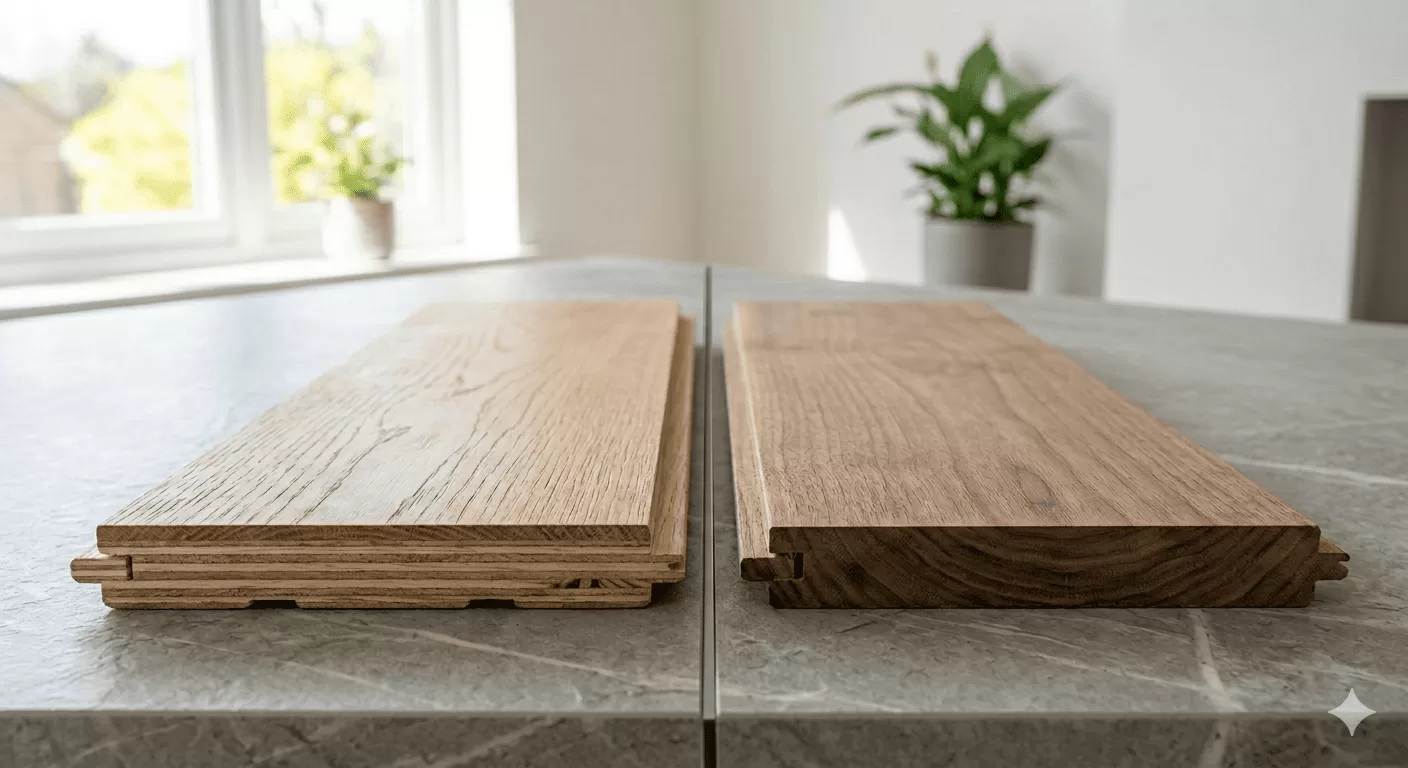
Solid hardwood flooring consists of planks milled from a single, continuous piece of timber. A premium local species like Merbau is harvested, cut to size, kiln-dried, and profile-matched (typically with tongue-and-groove edges). What you see on the surface is identical to what exists through the entire thickness of the plank, usually around 15mm to 18mm of pure, dense tropical hardwood.
Engineered Wood Flooring
Engineered wood flooring is a composite product made of real wood, but constructed in cross-directional layers.
The Top Layer (Wear Layer): A real hardwood veneer (typically 2mm to 4mm thick) that dictates the species look, grain pattern, and initial texture.
The Core Layers: Beneath the veneer lies a multi-layer core made of plywood, blockboard, or softwoods. These layers are stacked in a cross-grain pattern, each running perpendicular to the next and bonded under high pressure with industrial adhesives.
The Tropical Climate Showdown: Moisture & Stability
In Malaysia, the single greatest threat to timber flooring is not foot traffic—it is hygroscopic movement. Wood is a natural, porous material that breathes; it absorbs moisture from high relative humidity and releases it when the environment dries out (such as when air conditioning is running at full blast).
When wood absorbs moisture, it expands. When it dries, it contracts.
How Solid Hardwood Behaves
Because a solid hardwood plank is uniform throughout, its natural fibers all expand and contract in the same direction. If solid wood flooring is exposed to sustained high humidity without proper acclimatization or structural gaps, the planks will push against one another. This leads to common installation failures such as:
- Cupping: The edges of the plank rise higher than the center.
- Crowning: The center of the plank bulges upward.
- Buckling: The floor lifts entirely off the subfloor slab.
To prevent this, solid hardwood requires highly precise kiln-drying (reducing internal moisture content to a stable equilibrium point of around 11% to 14% for Malaysia) and experienced installation teams who calculate proper expansion gaps along the perimeter.

How Engineered Wood Behaves
Engineered wood flooring was structurally designed to solve the problem of dimensional instability. Because its plywood or composite core layers run in alternating perpendicular directions, the natural expansion of one layer counteracts the contraction of the layer next to it.
The Physics of Cross-Grain Ply: By neutralizing internal tensile forces, engineered wood flooring reduces the overall expansion and contraction rate by up to 50% compared to solid hardwood.
Consequently, engineered flooring is highly resilient against the dramatic humidity fluctuations common in Malaysian properties, such as corporate offices or homes where air conditioning is turned on during the day and switched off at night.
Installation Realities: High-Rise Condos vs. Landed Properties
The architectural layout of your Malaysian property heavily influences which flooring material is physically viable.
| Characteristic | Solid Hardwood Flooring | Engineered Wood Flooring |
| Installation Method | Glue-down, nail-down, or onto plywood subfloor | Floating floor (click-lock/glue joint) or direct glue-down |
| Subfloor Requirements | Perfectly level concrete or underlying timber batten system | Can tolerate minor subfloor imperfections; installs over foam |
| High-Rise Suitability | Challenging (adds height, requires acoustic management) | Highly Recommended (fast installation, low profile) |
| Landed Property Suitability | Excellent (ground floor requires robust moisture barrier) | Excellent (requires underlying vapor barriers) |
Restrictions on high-rise buildings
High-rise developments in Kuala Lumpur, Penang, and Johor Bahru feature concrete floor slabs. Installing solid hardwood on concrete requires plywood or wooden battens, introducing two key challenges:
- Floor Height Elevation: Plywood and thick solid timber raise floor levels by 25mm to 35mm, creating height conflicts with doors, cabinetry, and tiling.
- Acoustic Telegraphing: Solid wood fastened rigidly to concrete easily transmits footstep noise to the unit below.
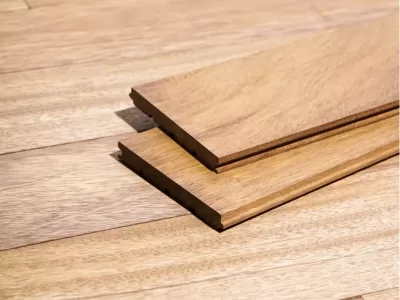
Engineered wood flooring installs as a floating floor. Planks join via click-lock or tongue-and-groove over a thin acoustic foam underlayment. It avoids subfloor nailing, keeping the profile under 15mm and dampening sound to meet strict condo guidelines.
Longevity, Maintenance, and Generational Value
Solid hardwood is the undisputed champion of lifespan and long-term return on investment (ROI).
The Refinishing Factor
Over decades of use, real wood floors accumulate surface scratches, minor dents, or UV discoloration from tropical sunlight. When this happens, a solid hardwood floor can be completely sanded down to raw wood, re-stained, and re-sealed with a fresh protective topcoat.
Because the plank is solid timber all the way through, it can undergo this deep sanding process 5 to 7 times over its lifespan. A properly maintained solid hardwood floor can easily last 50 to 100 years, turning into a multigenerational asset.
In contrast, engineered wood flooring can only be sanded while its top wear layer remains intact. A thin 2mm wear layer can only be lightly sanded once or twice. Cutting past that premium veneer exposes the structural plywood core underneath, ruining the floor. Consequently, the typical lifespan of engineered flooring is 20 to 30 years.
The Verdict: Which is Better for Your Malaysian Property?
Choosing between these two premium options depends entirely on your project variables:
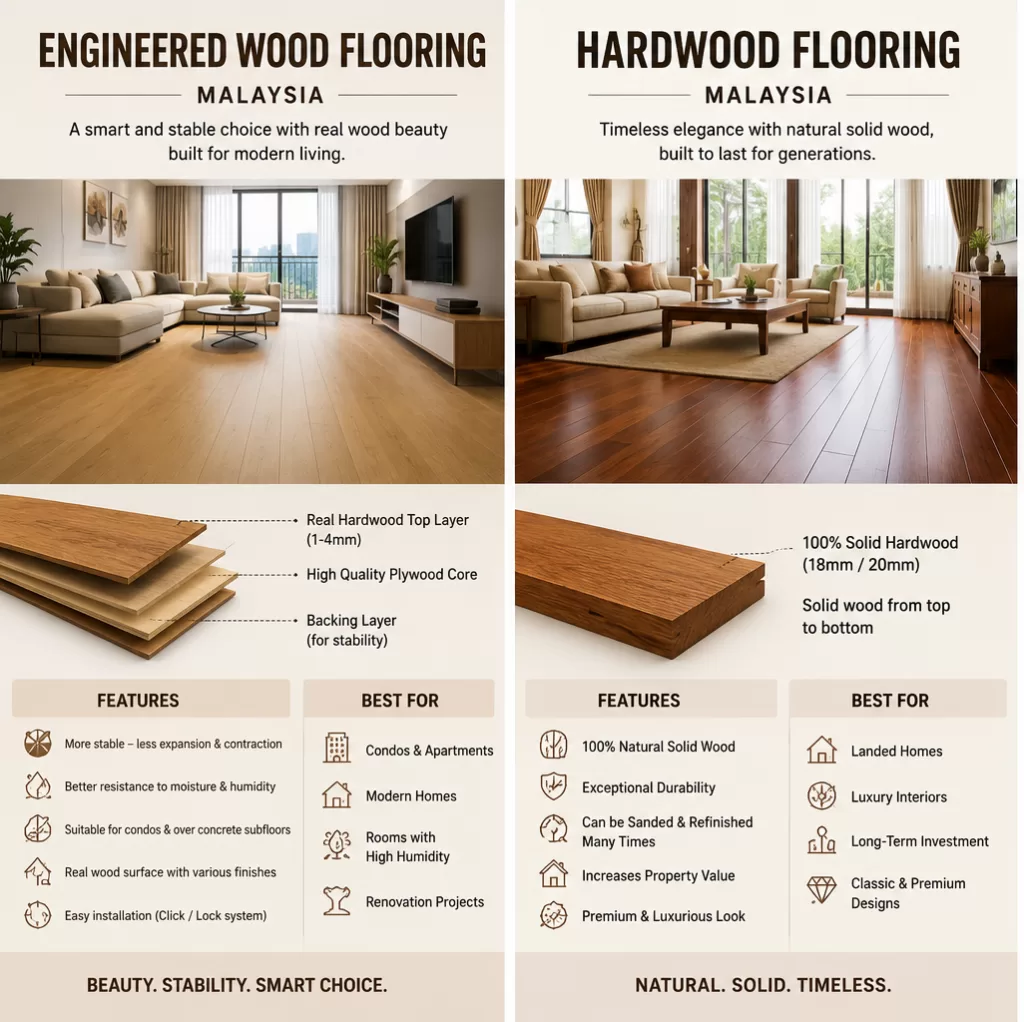
Choose Engineered Wood Flooring if: You are renovating a high-rise luxury condominium or corporate office tower, need a faster and lower-profile installation, want maximum resistance to sudden indoor humidity shifts, and are working within a strict floor-thickness threshold.
Choose Solid Hardwood Flooring if: You are developing or upgrading a premium landed property, an ancestral home, a luxury retail showroom, or a high-end architectural space where generational durability, absolute acoustic density underfoot, and the prestige of 100% solid natural timber are non-negotiable.
Elevate Your Space with Benwoods: Malaysia’s Premium Timber Specialists
Whether your architectural design demands the unmatched structural stability of modern flooring design or the timeless, generational prestige of solid timber, the foundational key to success is sourcing properly processed, climate-tested materials from an expert supplier.
As a trusted timber flooring supplier in Malaysia with over a decade of dedicated industrial expertise, Benwoods specializes in delivering premium Merbau Solid Hardwood Flooring Solutions tailored to the rigors of our tropical climate.
Merbau is globally acclaimed for its exceptional, natural termite resistance, and rich, deep reddish-brown aesthetics. At Benwoods, our Merbau timber undergoes rigorous, state-of-the-art kiln-drying and conditioning to ensure it achieves perfect moisture equilibrium before it reaches your site, practically eliminating the risk of cupping, warping, and structural failure. Backed by IPPC / ISPM 15 certified quality standards and scalable production capacities, we provide developers, architects, and premium homeowners with reliable, sustainable, and tailored timber supply chains across Malaysia.
Find the Right Timber Flooring for Your Space
Looking for quality timber flooring for residential or commercial use in Malaysia? Benwoods supplies timber flooring solutions designed for durability, appearance, and long-term performance.
Frequently Asked Questions (FAQs)
Is engineered wood flooring better than hardwood flooring for Malaysian properties?
Both options excel depending on the property type. Engineered wood flooring in Malaysia is highly recommended for high-rise condominiums and corporate offices because its cross-layered core prevents warping and buckling in fluctuating air-conditioned environments. Solid hardwood flooring in Malaysia remains the premium choice for landed properties and luxury spaces due to its generational longevity and multi-refinishing potential.
How does Malaysia’s tropical climate affect engineered vs. solid hardwood flooring?
High humidity causes natural timber to absorb moisture and expand, while air conditioning causes it to contract. Solid hardwood requires precise kiln-drying to a stable 10–12% moisture level and expert installation to manage this expansion. Engineered wood flooring reduces this dimensional movement by up to 50% because its alternating perpendicular layers naturally counteract internal structural forces.
Can engineered wood flooring be sanded and refinished like solid hardwood?
Solid hardwood flooring can be sanded completely down to raw wood and refinished 5 to 7 times over its lifespan, lasting up to a century. Engineered wood flooring can only be lightly sanded 1 to 2 times, depending on the thickness of its top real-wood wear layer (typically 2mm to 4mm). Sanding past this premium veneer exposes the composite core, meaning engineered floors have a shorter overall lifespan of 20 to 30 years.
Which option is easier to install in high-rise condominiums in Kuala Lumpur or Penang?
Engineered flooring is significantly easier to install in high-rise settings. It can be laid down as a “floating floor” directly over concrete slabs using a thin acoustic foam underlayment, keeping the profile under 15mm and dampening impact noise. Solid hardwood typically requires a thicker structural plywood underlayment or wooden battens anchored to the concrete, which raises floor heights by 25mm to 35mm and can create conflicts with doors and built-in cabinetry.
Does Benwoods supply both engineered and solid hardwood options for Merbau flooring?
Yes. As a premier timber specialist, Benwoods provides premium Merbau solutions across both categories. Our solid hardwood planks are strictly kiln-dried to ideal moisture equilibrium for maximum local climate stability, while our engineered wood flooring options combine the genuine, deep reddish-brown elegance of Merbau with a highly stable multi-layer core designed for modern urban developments.
About the Author

The Benwoods Packaging Insights Team brings years of experience in manufacturing and supplying high-quality wooden crates across Malaysia. Specializing in custom storage and shipping solutions, they provide expert guidance to help businesses protect goods, optimize logistics, and improve warehouse efficiency. Their insights are grounded in practical industry knowledge and proven expertise.