
When you compare quotes for export packing, it’s tempting to treat a wooden crate like a commodity. In practice, that’s how “savings” become damage claims, rework, or delays at the port. A crate is engineered transport equipment—not just timber and nails.
If you’re selecting a Wooden crate supplier malaysia exporters can rely on for machinery, industrial parts, or high-value goods, price should be a filter—but not the decision. What matters is whether the supplier can consistently deliver a crate that fits your handling method, stacking realities, export requirements, and the abuse of real logistics.
Below is a practical checklist of what to ask, what to inspect, and what “good” looks like—especially around engineering, bracing/blocking, and ISPM 15 readiness.
Why “cheapest crate” is rarely the lowest total cost
Price is visible upfront; performance becomes visible when something fails. Total cost usually shows up in predictable ways:
- Damage risk: weak blocking, poor load distribution, or inadequate fasteners can let cargo shift and get hit from inside the crate.
- Handling failure: forklift entry, lift points, or base stiffness may not match how the crate will actually be moved at origin, port, and destination.
- Export disruption: incorrect or inconsistent IPPC/ISPM 15 marking, or mixed untreated wood, can trigger clearance problems.
- Rework and delays: last-minute strengthening at a forwarder’s yard (or at port) often costs more than building it right initially.
The cheapest quote is often cheaper because it excludes engineering thinking and quality controls that reduce risk.
Engineering first: a crate should be designed around your cargo and handling
Many buyers provide only outer dimensions and weight, then end up with a crate that’s overbuilt in one area and weak in another. A capable supplier should ask the right questions and translate them into a purpose-built design.
What a supplier should ask before confirming a design
- Cargo characteristics: weight, centre of gravity, fragile points, protrusions, and components that can’t take compression.
- Restraints: can the item be bolted down, banded, or blocked? Are there base holes or skids from the manufacturer?
- Transport mode: sea vs air, FCL vs LCL, and whether transloading is likely.
- Handling method: forklift, pallet jack, crane, or mixed handling across multiple depots.
- Environment: moisture exposure, long storage, corrosion sensitivity, and whether barrier packing/desiccant is required (even if subcontracted).
When these are skipped, the crate becomes guesswork—rarely “cheap” once the shipment is moving.
Look for design capability, not just carpentry
Speed is useful, but for heavy or awkward loads you also want a supplier that can explain why the base, runners, and braces are sized the way they are. If your cargo includes machinery, pumps, motors, panels, or fabricated frames, treat crating as engineered packaging—not “copy last time.”
A simple capability check: can the supplier propose an engineered base or model load distribution when needed? Benwoods, for example, offers 3D pallet engineering design, which is often relevant because many crate failures begin with an underbuilt base.
Bracing and blocking: the difference between a box and a protective system
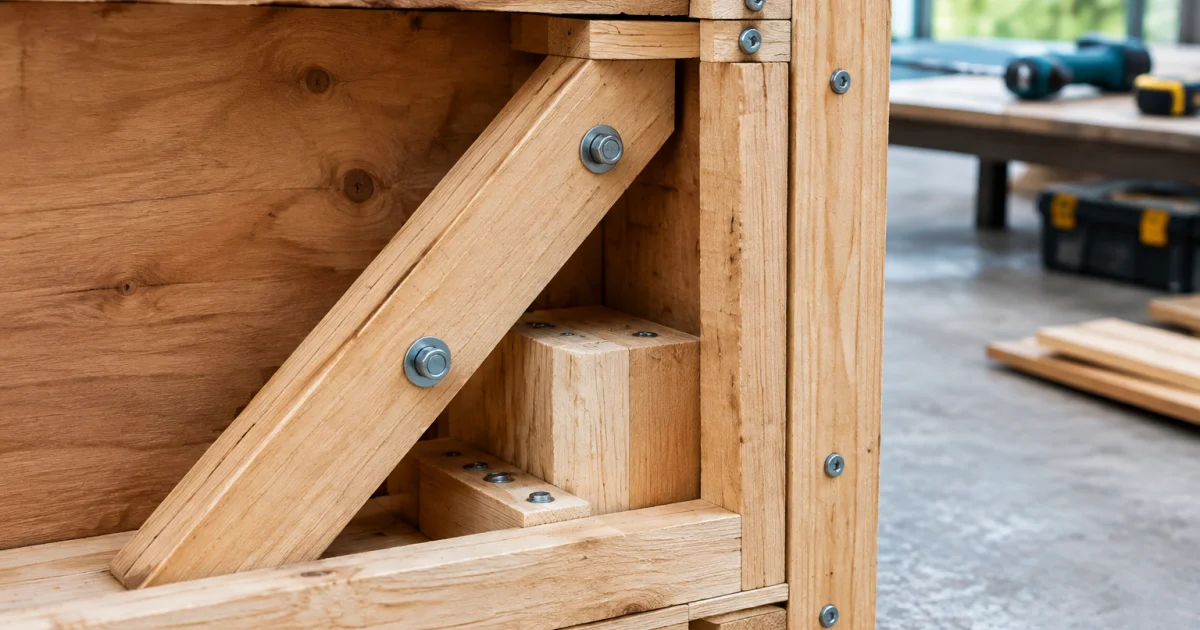
Most crate damage comes from movement: shifting, vibration that loosens restraints, drops, and side impacts. Bracing and blocking are what stop that movement. This is where strong suppliers separate from low-bid shops.
Internal blocking: keep the load from “walking”
Blocking is the internal “furniture” of the crate—chocks, cleats, saddles, and spacers that locate the cargo so it cannot slide. Effective blocking:
- Contacts strong load-bearing points (not thin covers or fragile housings).
- Prevents movement in all directions, not only front-to-back.
- Accounts for vibration and repeated shocks over long routes.
If the design assumes a static load sitting quietly, it’s designed for a workshop—not the supply chain.
Cross bracing: resist racking during handling and impacts
Crates can rack (skew) when turned by a forklift, pushed, or impacted. Diagonals and cross bracing help the crate hold its shape—especially for tall crates, top-heavy cargo, and LCL shipments where other freight may press against your crate.
Ask where racking loads might come from and how the design resists them. You don’t need a long report, but you do need a clear answer.
Fasteners and joinery: nails are not all the same
Fasteners are easy to ignore until a panel loosens or a runner starts to pull away. A performance-focused supplier chooses fastening based on:
- Withdrawal resistance: where pull-out forces are expected.
- Shear strength: where sideways forces dominate.
- Serviceability: whether the crate may be opened for inspection and re-closed securely.
You don’t need to micromanage nail types, but you should expect consistent workmanship: straight, properly spaced fastening; minimal splitting; no patching with random scraps.
ISPM 15 readiness: compliance is more than a stamp
For export, compliant wood packaging often matters. “ISPM 15” is the shorthand, but in practice you need a controlled process so the wood used is actually eligible and remains traceable.
What to verify with your supplier
- In-house treatment capability or controlled sourcing: if they claim heat-treated packaging, ask how they prevent mixing treated and untreated components.
- Correct marking practices: marks should be applied consistently and not only on removable parts.
- Documentation readiness: requirements vary, but the supplier should support your forwarder with clear packing details when needed.
Benwoods provides IPPC heat treatment & ISPM 15 export readiness as part of its packaging workflow. Integrated treatment is typically easier to control than treating compliance as an afterthought.
Note: destination rules can differ by market and cargo type. Your forwarder/importer should confirm what applies; your supplier should build in a way that keeps you consistently eligible.
Material and build quality: what to check during supplier evaluation
Even the right design can fail with inconsistent timber or rushed assembly. When evaluating (or re-evaluating) a supplier, look for observable execution quality.
Timber selection and consistency
You’re not buying furniture-grade wood, but you are buying structural packaging. Check for:
- Boards/runners that aren’t heavily warped or cracked.
- Reasonably consistent thickness and cut accuracy.
- Moisture control appropriate for sea freight or long storage.
Some buyers search for a “solid timber wood supplier malaysia” because disciplined timber sourcing often correlates with consistent crate output. The point isn’t to buy timber; it’s to buy repeatable structural quality.
Base design: treat the skid like the foundation
The base takes the worst abuse: forklift strikes, dragging, container floor friction, and point loads. A good base typically has properly sized runners, adequate fork clearance, and reinforcement where the cargo concentrates weight.
If you also rely heavily on pallets, a supplier with pallet-manufacturing discipline can be an advantage. Benwoods supports industrial wooden pallet solutions for export operations, and that base-building experience often translates into safer crate skids.
Fit, closure, and inspection practicality
Crates are sometimes opened for inspection. If opening destroys the structure—or re-closure is weak—risk increases at the worst time. Ask:
- How lids are fixed and how they can be re-fixed after opening.
- Whether access panels or screw-fixed closures are used when inspection is likely.
- How edges/corners are protected from splitting during opening and re-closure.
How to compare quotes fairly (a practical checklist)
If you only compare dimensions, timber thickness, and price, you’ll miss key performance drivers. Use this checklist to compare any wooden crate supplier, including those offering Custom wood crates for machinery and export cargo.
Quote comparison checklist
- Scope clarity: Does the quote specify internal blocking, bracing approach, base design, and closure method?
- Handling assumptions: Is forklift entry direction defined? Is crane lifting considered?
- Compliance readiness: Is ISPM 15/IPPC heat treatment included where needed, with controlled process?
- Quality controls: Are checks in place for fastener consistency, timber condition, and workmanship?
- Lead time realism: Does the timeline allow for design, build, treatment, and packing?
- Change management: If cargo dimensions change (common with fabricated equipment), how is the design updated?
If two quotes differ, ask “what is missing?” before “who is cheaper?” Often the lower price assumes less blocking, fewer braces, lighter base members, or looser compliance controls.
Questions that reveal capability quickly
- “Where will you block the load, and what movement are you preventing?”
- “What failure mode are you designing against: racking, base sag, fastener pull-out, or internal shifting?”
- “If customs opens the crate, can it be re-closed without weakening?”
- “How do you ensure treated and untreated wood never get mixed?”
Specific, confident answers usually indicate a real packaging partner.
Conclusion: buy risk reduction, not just timber
Budgets matter, but exporters and manufacturers should pay for certainty where it reduces predictable risk: damage, rework, non-compliance, and delays caused by poor handling fit.
When you evaluate a Wooden crate supplier malaysia shippers trust, focus on engineering thinking, bracing and blocking discipline, fastener and base integrity, and ISPM 15 readiness as a managed process. A crate isn’t a box—it’s part of your logistics system, and it should perform like one.
For additional context on export crating options, see Benwoods’ product page for custom made crates.
Frequently Asked Questions
What information should I give a wooden crate supplier before they quote?
Provide cargo dimensions, weight, centre of gravity (if known), photos or drawings, fragile points, and how it will be handled (forklift, crane, pallet jack). Also share the shipment mode (air/sea, FCL/LCL) and whether inspections or long storage are likely, so the supplier can design blocking, bracing, and closure appropriately.
How do I judge whether a crate is properly braced and blocked?
A properly protected load should not be able to shift in any direction once secured. Look for blocking that contacts strong parts of the cargo (not thin covers), diagonal or cross bracing that resists racking, and a base that supports concentrated loads without flexing. If the supplier can explain the movement they are preventing, that’s usually a good sign.
Is ISPM 15 compliance just about stamping the crate?
No. The mark matters, but compliance depends on using eligible treated wood and controlling the process so treated and untreated components aren’t mixed. A capable supplier should explain how heat treatment is handled (in-house or controlled sourcing), how marking is applied, and how they support packing details for your export workflow.
Are custom wood crates always better than standard crates?
Not always. Custom wood crates are most valuable when the cargo has unusual weight distribution, sensitive points, or specific handling constraints. For more uniform goods, a standard design may be sufficient. The key is that the design matches your load, route, and handling method—not that it’s “custom” for its own sake.
What’s the biggest hidden risk when choosing the lowest-priced crate supplier?
The biggest hidden risk is under-specification: missing internal blocking, lighter base construction, weaker bracing, or inconsistent workmanship. Those gaps may not be obvious at pickup, but they can lead to shifting, damage, or rework during transit—costs that typically exceed the initial savings.
Need export-ready crates built for real handling conditions?
Benwoods supports exporters, manufacturers, and engineering teams with engineered wooden packaging—covering crate design, bracing and blocking, and ISPM 15/IPPC heat treatment readiness under one roof. If you want a quote that reflects your cargo, handling method, and shipping route (not just outer dimensions), talk to our team about your requirements.
