
When timber fails in industrial use, the symptoms are obvious: pallets twist, crates go out of square, boards cup or split, and mould shows up in storage or transit. The causes are often less visible—excess moisture, uneven drying, and biological risk in untreated wood. For manufacturers, exporters, logistics teams, and furniture makers, timber stability affects safety, cargo protection, and whether packaging arrives fit for use.
If you are evaluating a Timber supplier malaysia for pallets, crates, processed timber, or export packaging, it helps to understand two core processes that improve reliability: heat treatment and kiln drying. They’re related, but not the same. Specifying the right treatment for your application is one of the most effective ways to reduce warping, mould, and pest risk.
Below is a practical breakdown of what each process does, what problems it solves, and how to specify treated timber for common industrial applications.
Why industrial timber warps, moulds, or attracts pests
Wood is hygroscopic—it exchanges moisture with the air. As moisture changes, wood changes dimension. That movement is behind many failures in packaging and components.
In industrial settings, three risk categories appear most often:
- Warping and distortion (bowing, cupping, twisting): commonly linked to uneven moisture content, rapid/uneven drying, and poor storage.
- Mould and staining: grows when timber stays damp, especially in humid environments or tightly stacked loads with low airflow.
- Pest risk (insects/larvae): a major export concern and also a local storage issue when raw timber isn’t treated.
Even a well-designed pallet or crate can fail if the timber isn’t conditioned for the environment it will face. That’s why industrial buyers increasingly ask not only “What size and load?” but also “How was the wood treated and handled after treatment?”
Heat treatment vs kiln drying: what’s the difference?
- Heat treatment: primarily for phytosanitary control—controlled heating to reduce pest risk in wood packaging, commonly required for export compliance.
- Kiln drying: primarily for moisture control—reducing and balancing moisture content to improve dimensional stability and reduce mould/warping risk.
A supplier may offer one or both depending on the end use. Export packaging often needs heat treatment for compliance, while timber components and interior applications often prioritize kiln drying for stability and finishing quality.
Why the distinction matters for industrial buyers
If the issue is pallet wobble, twisted runners, or crates deforming in storage, moisture control (kiln drying plus proper handling) is usually the bigger lever. If the issue is export delays or rejection, heat treatment and correct compliance practices matter most. Many operations need both: packaging that is compliant and stable.
How kiln drying reduces warping and mould risk
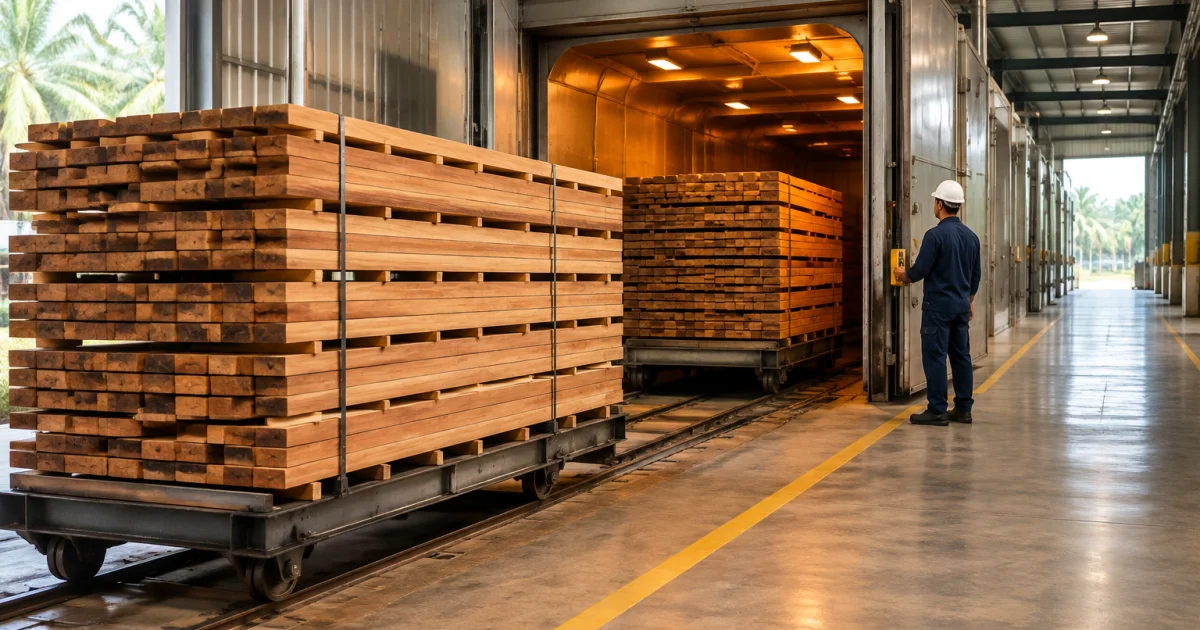
Kiln drying uses a controlled chamber to remove moisture more consistently than air-drying. While settings vary by species and thickness, the goal is the same: lower moisture in a controlled way to reduce drying defects and future movement.
For pallets, crates, and processed timber components, kiln drying helps by:
- Improving moisture consistency, reducing unpredictable shrinkage after assembly (less twist, cupping, and out-of-square builds).
- Lowering mould likelihood, especially during staging or container loading where ventilation may be limited.
- Supporting cleaner machining and assembly, because overly wet timber can tear during cutting and later loosen fasteners as it dries.
- Improving finishing stability for processed timber and some flooring-related components.
Kiln drying doesn’t make wood immune to humidity; timber can reabsorb moisture if stored poorly. It does, however, provide a more stable starting point and reduces extreme swings that drive distortion.
Practical storage tips that protect kiln-dried timber
- Store off the floor and away from rain exposure.
- Keep stacks strapped or weighted to reduce movement as timber acclimatises.
- Maintain airflow around stacks; avoid wrapping that traps condensation.
- Use FIFO to prevent long storage in damp areas.
How heat treatment reduces pest risk for export packaging
Heat treatment is widely specified for wood packaging materials to reduce pest transfer risk. Exporters often choose heat-treated pallets and crates to reduce the chance of issues at destination inspections.
For industrial buyers, heat treatment supports:
- Reduced insect/larvae risk in wood packaging material.
- Better alignment with export requirements when the supplier is set up for IPPC/ISPM 15-related processes.
- More consistent control when treatment is done in-house with fewer handoffs.
Heat treatment is not the same as kiln drying and doesn’t automatically mean the wood is dry enough for dimensional stability. Depending on your risk profile (pests vs moisture movement), you may specify one process or combine both.
Where heat-treated timber matters most
- Export pallets for containerised shipping
- Custom wooden crates for machinery and heavy equipment
- Bracing and blocking inside crates (often a compliance weak point if untreated)
- Mixed-material packaging where timber still must meet wood-packaging rules
Choosing treated timber for pallets, crates, and industrial timber components
Once you know what each process does, the next step is specifying requirements clearly so production and performance match expectations.
1) Wooden pallets for warehouses and manufacturing
Pallets face repeated impacts, fork-entry stress, and humidity changes across storage and transport. When sourcing from a wooden pallet supplier malaysia, align on:
- Operating environment: indoor vs semi-outdoor staging; higher humidity increases mould and movement risk.
- Load profile: static/dynamic load, stacking pattern, point loads, and whether pallets will be racked.
- Moisture strategy: kiln-dried components can reduce warping that causes wobble on conveyors and uneven stacking.
- Export vs local use: export pallets may require heat treatment and correct handling throughout manufacturing and storage.
If you have recurring breakage or deformation, ask for a design review (board thickness, nailing pattern, runner selection) instead of repeating the same specification.
2) Custom wooden crates for machinery and sensitive goods
Crates must stay square so bracing remains effective and lids fit correctly. Warping can weaken joints and compromise protection. In addition to heat treatment for export, discuss:
- Timber conditioning for panels and framing to reduce twist over long transit periods.
- Bracing/blocking strategy to prevent cargo movement.
- Fastener choice suited to timber density and expected vibration.
For high-value cargo, timber treatment should be viewed as part of packaging engineering, not a checkbox.
3) Processed timber, finishing, and precision parts
For manufacturers and furniture producers, consistent moisture content reduces machining variation and assembly gaps. Kiln drying supports:
- More predictable planing and cutting
- Reduced post-machining movement
- More consistent finishing outcomes
If you need precision-processed timber, working with a supplier that integrates selection, processing, and treatment helps maintain batch-to-batch consistency. See Benwoods’ Processed Timber Finishing for related capability.
4) Timber flooring and interior timber applications (where relevant)
Some industrial buyers also handle facility upgrades where timber flooring is used. The same fundamentals apply: controlled moisture and stable processing reduce post-installation movement. Benwoods resources include Timber Flooring Supplier Malaysia and Engineered Wood Flooring Vs Solid Hardwood Flooring In Malaysia.
What to ask a timber supplier before you place an order
The fastest way to improve outcomes is to specify performance, not just dimensions. Procurement and operations teams can ask:
- Which treatment do we need for this use case? (Heat treatment for export compliance, kiln drying for moisture control, or both.)
- How is moisture managed after treatment? Storage and handling determine whether timber reabsorbs moisture before assembly.
- Can you support custom engineering? Pallet/crate design should match load distribution, handling method, and cargo constraints.
- Do you manufacture and treat in-house? Fewer handoffs often improves consistency and scheduling control.
- What sustainability options are available? Recycled pallets or refurbishment programmes may reduce waste and cost.
Internally, document the failure mode you want to eliminate (e.g., mould during staging, pallet twist on racking, crate panels bowing in transit). Clear problem statements help a supplier recommend the right treatment and build.
Useful next reads for export and packaging buyers
- IPPC Heat Treatment Kiln Dried Service
- Why ISPM 15 Heat Treatment Matters For Export Pallets
- Optimising Costs And Sustainability With Wooden Pallets Industrial Export Solutions
- Custom Made Crates
- Furniture Components Interior Woodwork
Conclusion: treatment is risk control, not a premium add-on
Warping, mould, and pests are predictable industrial timber risks tied to moisture, processing consistency, and biological exposure. Kiln drying reduces moisture-driven movement and mould likelihood; heat treatment reduces pest risk and supports export packaging requirements. Chosen deliberately—and supported by correct handling and fit-for-purpose design—these processes make pallets, crates, and timber components more reliable across warehousing, manufacturing, and international shipping.
When comparing suppliers, look beyond size and price. Compare treatment capability, in-house process control, and the ability to engineer pallets and crates around your real operating conditions.
Frequently Asked Questions
Is heat-treated timber the same as kiln-dried timber?
No. Heat treatment is mainly used to reduce pest risk for wood packaging (often for export compliance), while kiln drying focuses on lowering and balancing moisture content to improve stability and reduce warping or mould risk. Some suppliers provide both, depending on the application.
Will kiln-dried timber stop warping completely?
Kiln drying reduces the likelihood of warping by improving moisture consistency, but it cannot eliminate movement entirely because timber can still gain or lose moisture in storage and use. Correct storage (ventilation, off-floor stacking, avoiding trapped condensation) is also important.
When do exporters need heat-treated pallets or wooden crates?
Exporters often specify heat-treated wooden pallets and crates when shipping internationally to reduce the risk of pest-related issues and to align with common wood-packaging requirements. It’s best to confirm destination and customer requirements early and ensure the supplier can support compliant treatment processes.
What should I tell a wooden pallet supplier in Malaysia to reduce mould issues?
Describe where mould appears (warehouse zone, outdoor staging, container loading), how long pallets sit before use, and whether they are wrapped or tightly stacked. Ask about moisture control options (including kiln drying), post-treatment handling, and storage recommendations to keep timber dry and ventilated.
Does treated timber matter for processed timber and furniture components?
Yes. For processed timber, precision parts, and furniture components, controlled moisture content supports more consistent machining, assembly fit, and finishing results. Kiln drying is commonly used to improve stability and reduce post-processing movement.
Need stable, export-ready timber packaging? Talk to Benwoods
Benwoods supports industrial buyers with integrated wood solutions—wooden pallets, custom-made wooden crates, processed timber, and in-house IPPC heat treatment and kiln drying to help reduce warping, mould and pest risk.
If you’re planning an export shipment, upgrading pallet performance, or specifying timber for manufacturing use, share your load details, handling method, and storage conditions. Our team can recommend the right treatment approach and packaging build for your operation.
